
Today’s world is boosting with powerful technologies and Artificial Intelligence (AI) solutions, finding fertile ground in many fields, including safety-critical Cyber-Physical Systems (CPSs). And REXASI-PRO’s use case is certainly one of these. If, on the one hand, the integration of AI models into wheelchair’s navigation system has the big potential of aiding users in their daily life activities, on the other hand, it is essential to determine when the system can operate safely and smoothly, doing no harm to people and the surrounding environment.
Reliable AI (RAI) activities in REXASI-PRO are then devoted to make AI systems behave “properly with a range of inputs and in a range of situations”. The starting point in conceptualizing RAI methods is provided by the simulation tool, Navground (https://idsia-robotics.github.io/navground/) from SUPSI, which allowed to generate data simulating agents’ motion in scenarios of interest. In particular, the focus was posed on the Cross scenario, where agents intersect in the middle of two corridors (Figure 1).
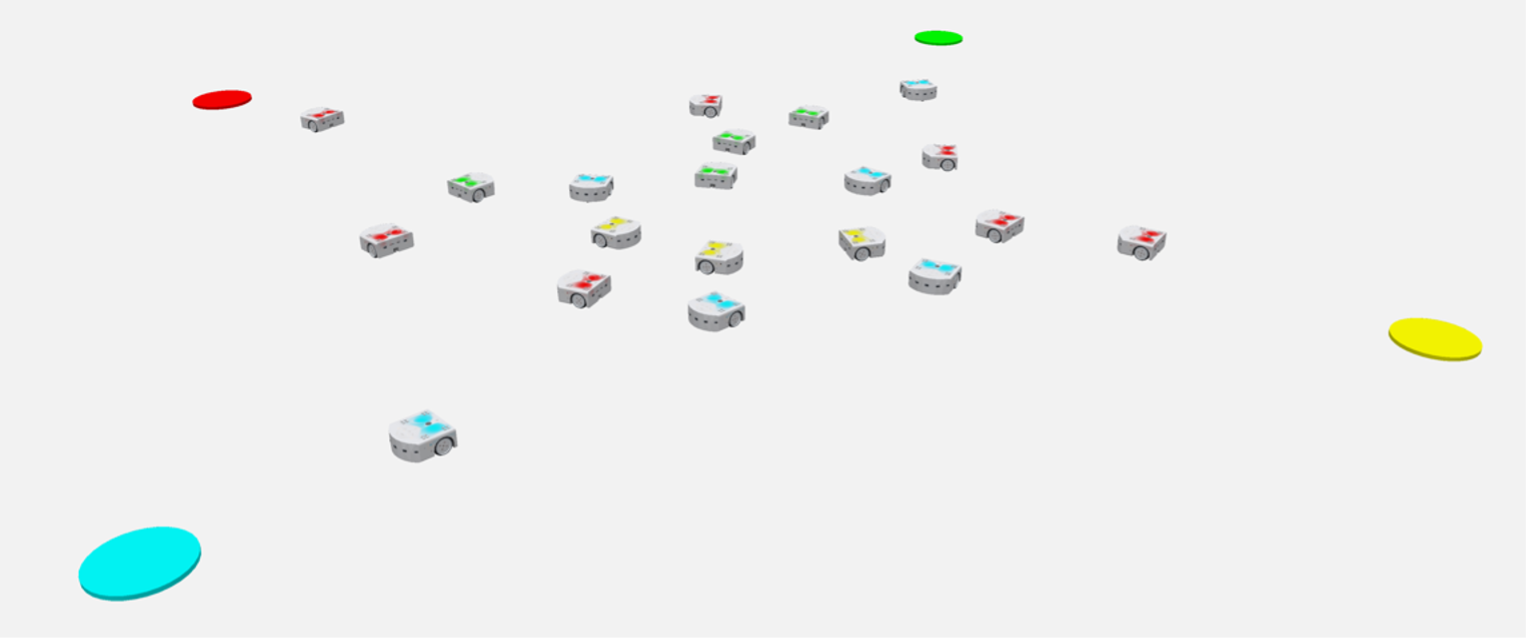
Agents’ dynamics is governed by laws inspired to pedestrians’ motion, i.e., following the Human-Like behavior, being described by some key parameters:
- A safety margin: the minimal distance to keep the agents away from obstacles/neighbors
- The minimal time required to stop before a collision occurs (eta?)
- The relaxation time controlling how much the motion smoothness
Leveraging on these simulation parameters, data-driven RAI methods have been designed to ensure collision-free navigation:
- Probabilistic Safety Regions and Conformal Safety Regions (resp., PSR and CSR), born from the combination of the newly introduced concept of Adjustable Support Vector Machine and well-grounded statistical theories[1], define the space of navigation parameters in which the absence of collisions can be guaranteed at a desired probability level.
- A local rule extraction method (Anchors[2]) is used to provide better insights into the PSR and CSR models, by finding easier-to-understand approximations of their boundaries.
- Tests with 10% error bound (i.e., 90% probability of being correct) revealed a good solution, able to reduce collisions while also setting a less conservative (i.e., lower) minimum value of safety margin (0.07 m) than the one known from model-based theory (0.34m).
More details about methods and results are available in the related conference paper: Narteni, S., Carlevaro, A., Guzzi, J., Mongelli, M. (2024). Ensuring Safe Social Navigation via Explainable Probabilistic and Conformal Safety Regions. In: Longo, L., Lapuschkin, S., Seifert, C. (eds) Explainable Artificial Intelligence. xAI 2024. Communications in Computer and Information Science, vol 2156. Springer, Cham. https://doi.org/10.1007/978-3-031-63803-9_22
The video below highlights the effect of the adopted RAI solutions for the collision avoidance task described above, especially showing the impact of safety margin on the occurrence of collisions. When it is kept very low (first part of the video), say, under 0.02 m, agents present more frequent collisions (red colored agents) between one another. Experts’ guidance can surely help setting the parameters more properly and reducing unsafe events, yet not being able to individuate precise thresholds on the required values (mid part of the video). When RAI techniques come into play (last part of the video), it is possible to probabilistically guarantee, by design, the absence of collisions, when safety margin and relaxation time keep under the boundaries of the individuated region. Therefore, this demonstrates how simulation and machine learning validation can and should keep strictly cooperating in reaching more and more efficient solutions.
[1] Carlevaro, A., Alamo, T., Dabbene, F., & Mongelli, M. (2023). Probabilistic Safety Regions Via Finite Families of Scalable Classifiers. arXiv preprint arXiv:2309.04627.